
Monday, February 11, 2013
Obituary - by Peter Comley
Keith Joubert An exceptional man
 Africa has lost a great talent. Keith Joubert was unquestionably one of the most gifted artists that this continent has produced. He was born in humble surroundings in Germiston in 1948, grew up in the tough Johannesburg suburb of Mayfair and passed away in the affluent northern part of Johannesburg at the end of January 2013 aged just 64.
Those bones of his life belie the compulsion he had to travel to remote places and commune with the wild to gather the mental images he needed to capture Africa – its animals, people and atmosphere – on canvas like no other before him. He had many imitators but before they could catch up he would simply raise his game. He changed forever the way Africa would be painted.
Joubert’s works hang in many major corporate and private collections around the world and his clients include royalty from Europe and the Middle East. He has held major exhibitions in many of the art capitals of the world including London, New York, Paris, Texas, Johannesburg and Kasane.
But to talk of Keith solely as an artist would be an injustice to my close friend and the godfather to my daughter. Over the twenty odd years that we were friends I came to know a man who embraced life more fully than anyone else I have met. Whether he was working, partying or travelling he did it, uncompromisingly, at full throttle. Half measures and mediocrity he despised as much as he did arrogance. He was at his most combative when it came to seeking solutions to conservation issues when his unique mind would seek answers from outside of the box. Where most followed convention Keith blazed new trails.
Success in this world of ours attracts material gain but Keith disdained the accumulation of objects and his sprawling farm home was almost spartanly furnished while his studios in the Botswana bush were tents or simple cabins.
The one thing that struck me most about Keith was his ability to treat everyone in the same jovial manner, whether she was a client from the British Royal Family or a petrol attendant at a dusty station he always engaged them in a similar friendly way. He caused many people to smile.
He leaves an empty hole in the lives of Val, the woman he loved so transparently and deeply, and his talented brother, Dereck and his wife Bev , as well as his beloved goddaughter - not to mention princesses, friends and petrol attendants from around Africa.
Go well my friend and may your soul have mercy on God because you know he can’t keep up.
Africa has lost a great talent. Keith Joubert was unquestionably one of the most gifted artists that this continent has produced. He was born in humble surroundings in Germiston in 1948, grew up in the tough Johannesburg suburb of Mayfair and passed away in the affluent northern part of Johannesburg at the end of January 2013 aged just 64.
Those bones of his life belie the compulsion he had to travel to remote places and commune with the wild to gather the mental images he needed to capture Africa – its animals, people and atmosphere – on canvas like no other before him. He had many imitators but before they could catch up he would simply raise his game. He changed forever the way Africa would be painted.
Joubert’s works hang in many major corporate and private collections around the world and his clients include royalty from Europe and the Middle East. He has held major exhibitions in many of the art capitals of the world including London, New York, Paris, Texas, Johannesburg and Kasane.
But to talk of Keith solely as an artist would be an injustice to my close friend and the godfather to my daughter. Over the twenty odd years that we were friends I came to know a man who embraced life more fully than anyone else I have met. Whether he was working, partying or travelling he did it, uncompromisingly, at full throttle. Half measures and mediocrity he despised as much as he did arrogance. He was at his most combative when it came to seeking solutions to conservation issues when his unique mind would seek answers from outside of the box. Where most followed convention Keith blazed new trails.
Success in this world of ours attracts material gain but Keith disdained the accumulation of objects and his sprawling farm home was almost spartanly furnished while his studios in the Botswana bush were tents or simple cabins.
The one thing that struck me most about Keith was his ability to treat everyone in the same jovial manner, whether she was a client from the British Royal Family or a petrol attendant at a dusty station he always engaged them in a similar friendly way. He caused many people to smile.
He leaves an empty hole in the lives of Val, the woman he loved so transparently and deeply, and his talented brother, Dereck and his wife Bev , as well as his beloved goddaughter - not to mention princesses, friends and petrol attendants from around Africa.
Go well my friend and may your soul have mercy on God because you know he can’t keep up.


Wednesday, January 9, 2013
FRESH PRODUCE

Friday, December 21, 2012
Nexus series - Totem Poles
One of the projects Keith has worked on this year is a series of totem poles
using old fence posts that are made from African hardwoods such as Leadwood (combretum imberbe) and Mopane (colophospetmum mopane).
This wood has stood rooted in the granitic soil of South Africa's lowveld for hundreds of years. First as a living tree, then later as cattle farming came to this wildlife area, these trees were shaped into everlasting corner posts for cattle fences.
They have weathered and baked in the lowveld heat, seasonally pounded by rain, and seared by droughts that we can only speculate upon. Every natural surface of these posts tells a story, and has been used by other species - great and small, as habitat or rubbing post.

Each post seems to house an individual spirit of its natural environment.
To work on them, Keiths studio was outside in the broken shade of a big old Bird Plum Tree (berchemia discolor) that is wrapped in a Python Creeper.

The theme of these totems is the nexus of life and death
The living tree, lives on in the fence posts and sculptural artworks. Each post is endorsed with images and bronze work, both gathered and formed by the artist. The images arise out of the sense of the ancient wood - each determined by forms, curves and fissures shaped by natural events in the history of the tree.


The bronze frogs were cast from a dessicated frog form that was collected from a sand track in northern Botswana and cast in bronze. The frog may have died crossing the baking sand too far from the nearest waterhole. The detail of its living form was perfectly preserved and has been cast to include the tiniest detail. The bronze frogs appear to be migrating along the fissures of the leadwood post.
Snakes are often used to symbolise transformation and change. They would also have investigated, and perhaps used, these very poles - as would the lizards of many colours. All form part of the living ancient landscape that is holistically encompassed in the Nexus series.
These totem poles can be viewed at
Everard Read Gallery, Johannesburg
Friday, August 24, 2012
Brothers

"Brothers"
30x40" or 76 x 102cm
oil on canvas
Cheetah brothers hunting in a coalition on the floodplains of Selinda Reserve, northern Botswana
SOLD
SOLD
Tuesday, March 27, 2012
Rhino Wars

"Rhino Wars"
1650 x 2500 cm
oil on canvas
SOLD
This is a spectacular large canvas with a lot of detailed line work. It deals with the current battles to conserve wild rhinos in Africa and Asia, and looks at the possibility that rhinos as a species could soon join the ranks of mythological creatures. The George and Dragon motif occurs across Europe from Russia, to the West, and in north Africa particularly Ethiopia. Thus it can be taken as an international symbol in this context
Saturday, February 25, 2012
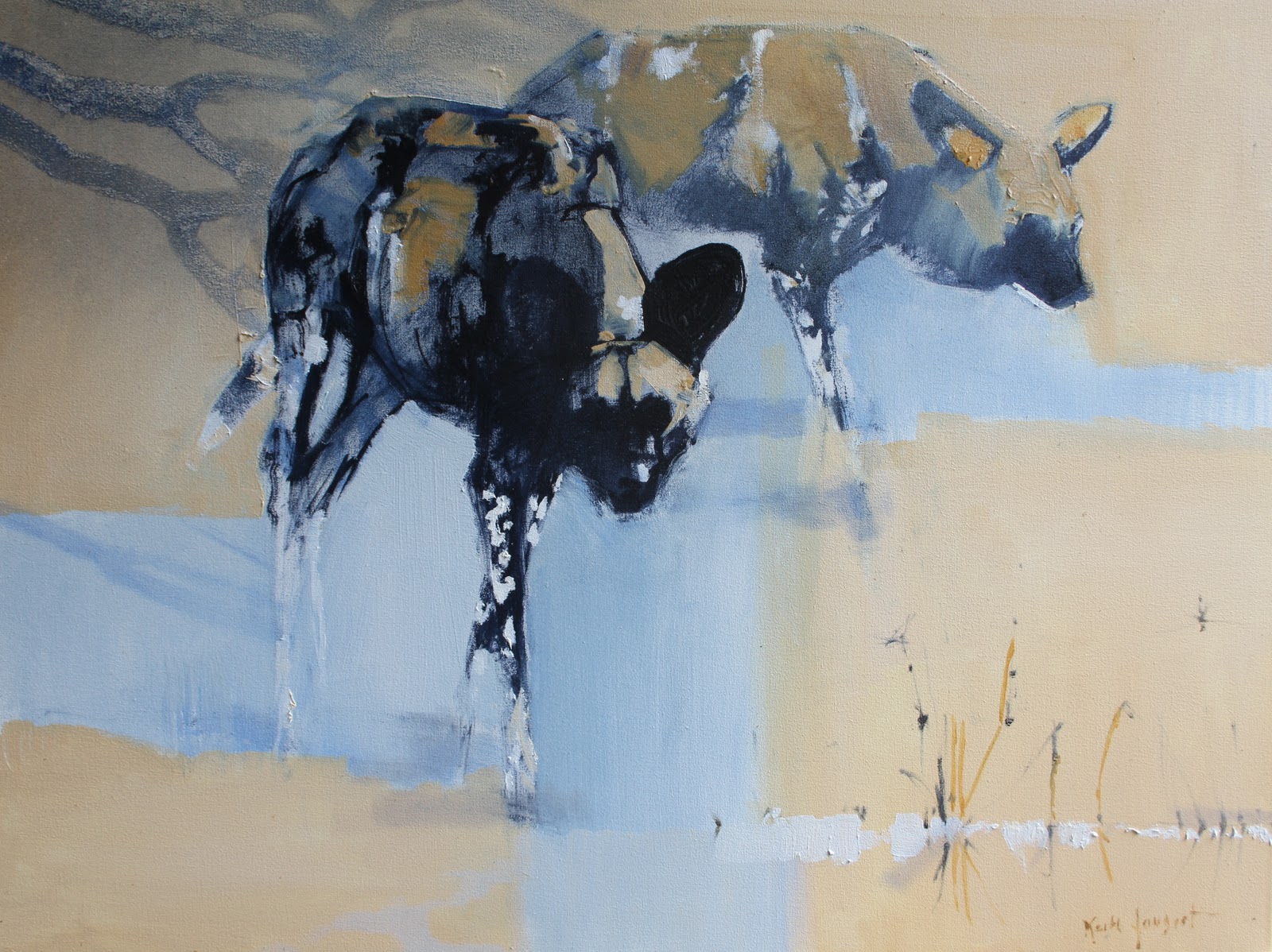
Hyena Plains

"Hyena Plains"
oil on canvas
43x75" or 109x191cm
This painting can be viewed at Everard Read Gallery, Cape Town, South Africa
'Pride Male' Limited edition Bronze sculpture

'Pride Male'
Limited Edition Bronze sculpture
Edition of 15
Granite base size 47cm long x 16cm wide x 7cm high
overall size of sculpture: 30cm high x 55cm long x 17cm Wide
This bronze can be viewed at the studio,
and at Everard Read Gallery, Johannesburg, South Africa
Tuesday, February 7, 2012
Spillway

"Spillway"
buffalo and lechwe herds on newly flooded plains
30x40" or 76 x 102cm
oil on canvas
SOLD
SOLD
herd structures

Masai herd structures
30x40" or 76 x 102cm
oil on canvas
traditional skills of animal husbandry create structures within the cattle herds
This painting can be viewed at Tryon Gallery, London, England
traditional skills of animal husbandry create structures within the cattle herds
This painting can be viewed at Tryon Gallery, London, England
Wednesday, February 1, 2012
Friday, January 13, 2012

Friday, December 30, 2011

Incident at Night

Incident at Night
oil on canvas
30x40" or 76x102cm
Fragments of inherited dreams and creatures of the imagination
that tingle our vestigial memories in the midnight hours
Monday, November 28, 2011
Ground Hornbill

Ground Hornbill
30"x40" / 76x102cm
oil on canvas
Ground hornbills are pondorous birds whose call is synonymous with sunrise
Ground hornbills are pondorous birds whose call is synonymous with sunrise
Monday, October 3, 2011
Water Play

"Water Play"
42x75" / 107x190cm
oil on canvas
It was hot afternoon and the elephant herds had gathered at the waterhole.
once they had slaked their thirsts and cooled their dusty hides
the play time began
SOLD
SOLD
Sunday, October 2, 2011
Sausage Flower Season

"Sausage Flower Season"
30x40" / 76 x 102cm
oil on canvas
During the early summer months when the Sausage Trees (kigelia Afrikaner) come into bloom
the falling blossoms attract various antelope species who come to feed on them around the base of the tree. This in turn attracts the nocturnal predation of leopards who come to prey on the antelope species.
Fresh

"Fresh"
30x40" / 76 x 102cm
oil on canvas
sub adult bull elephant charges out of the scrub bush
practising his adult skills with the verve and enthusiasm of his youth
Friday, September 2, 2011

Riverbend

"Riverbend"
30x40" or 76x102cm
oil on canvas
shadows and light in the riverine forest play on an elephant drinking at the bend in the river
Friday, August 26, 2011

Subscribe to:
Posts (Atom)